Best Practices

This “Best Practices” page is your go-to resource to maximize your success with Convoy Sage. From crafting effective email and LinkedIn messages to leveraging valuable data points, we’ve compiled actionable insights to help you connect with prospects, build stronger relationships, and drive results. 

Select an option to explore tips and best practices for each

LinkedIn

Connecting via LinkedIn works particularly well for scenarios where an immediate buying need does not appear to exist. Building a strong network directly increases your likelihood of future sales. 
Best Practices for Using Linked In Outreach:

  • Personalize Your Outreach: Start with a warm introduction that acknowledges something specific about the prospect, such as their role, company, or mutual connections. Avoid generic messages.
  • Be Brief and Clear: Keep your message concise, focusing on how the value the prospect will obtain from knowing you. 
  • Don’t Pitch Slap: High value prospects will be put off by salesy demands.
  • Follow Up Strategically: If you don’t hear back after 5-7 days, send a follow-up that delivers tangible value to the prospect. 
  • Use a Professional but Friendly Tone: Show professionalism while maintaining a conversational tone that feels approachable and genuine.

Example Messaging:

Messaging Examples

  • Hi [First Name], my company helped [Similar Company Name]achieve [name specific result]. I specialize in [specific result or benefit]. Here if you have any questions [about how to obtain that value].
  • Hi [First Name], your work at [Company Name] caught my eye, especially in [specific area of interest]. I’d love to explore how we could collaborate or share insights to help with [specific result, e.g., growth or efficiency]. 
  • Hi [First Name], here’s a [insert individualized report/deliverable] that you might find helpful. Happy to go over this in more detail if you are looking to [interesting value proposition].
  • Hey [First Name], just following up on my last message. I know things can get busy, but I’d love to connect and see if there’s an opportunity to work together. Let me know if you’re open to a quick chat! 

Email

Whether it’s a direct outreach, adding prospects to a nurture campaign, or including them in your newsletter, email is a powerful way to stay top of mind. Follow the best practices below for effective outreach, and see example emails to help you get started.

How to Find a Professional Email Address when only Personal Email is Grabbed 


  • Google the User’s Full Name and Location: This can lead to LinkedIn profiles or company pages where contact details might be listed.
  • Check LinkedIn: If their LinkedIn profile comes up, use it to either send a message (refer to the LinkedIn best practices) or check for an email address listed under their contact info.
  • Search Their Company Website: Some companies have directories or contact pages where employee emails follow a standard format.

    Note: This process may not always yield results, but it’s a great habit to spend a minute or two checking. Even if you don’t find an email, you might uncover other valuable insights about the visitor.

Best Practices for Using Email Outreach:

Example Messaging:

  • Don’t Blast! Unless..: If you plan to do a lot of prospecting, consider using a newsletter sending tool or a reputable cold emailing company. Otherwise, you risk your inbox getting flagged as spam.
  • Segment Your Audience: Organize your leads based on criteria like industry, job title, or company size. This helps tailor your messages for relevance and impact.
  • Use the Contact’s Work  Email: If the contact provided a personal email, research to identify their work email (see tips above).  Send emails using your company domain that matches your website. Example: example@convoysage.com
  • Personalize Your Emails: Include the recipient’s name, company name, or specific details that show you’ve done your homework. Generic emails are often ignored and can be sent to spam.
  • Include Clear Call to Actions: Always guide your recipients on the next step, whether it’s scheduling a call, visiting your site, or replying to your email.
  • Configure Your DNS Provider to Optimize Delivery: Ensure DKIM, SPF, and DMARC are configured for your domain. 
  • Add to Campaigns or Newsletters: Include your leads in your email campaigns or newsletters to keep them engaged with relevant content and updates over time. 
  • Keep It Short and to the Point: Your message should be concise, focusing on the benefit you offer and why they should respond.
  • Follow Up: Send polite follow-ups if you don’t get a response. Often, persistence pays off, but stop at three to five emails. This avoids your email getting flagged as spam. 

First Email Examples

  1. Subject Line: Great to Connect, [First Name]!

    Hi [First Name]!

    Congrats on  [specific accomplishment]. I specialize in helping companies in [industry/sector] [mention a specific benefit, e.g., streamline operations, increase conversions].

    I believe there could be an opportunity to help you with [specific pain point or need]. Would you be open to a brief conversation to explore how we can collaborate?

  2. Subject Line: Boosting [Company Name]’s [Benefit] – Let’s Talk


    Hi [First Name]


    There’s an opportunity for [Company Name] to improve [specific benefit, e.g., lead generation, process efficiency, offering]. Would a brief call to discuss [specialized interest] be of interest?


    You can easily book a time that works best for you using my Calendly link here: [Calendly Link].


  3. Subject: Helping [Company Name] with [Pain Point]


    Hi [First Name],

    I work with companies like [Company Name] to help them [solve a problem relevant to their industry/company]. There’s a great opportunity to [name the value proposition] for your company.

    Would you be open to a quick conversation to explore how we can help? 


  4. Subject: A Better Way to [Solve Problem]


    Hi [First Name],


    Companies in [industry] often struggle with [specific challenge]. That’s why we offer [Product], which helps with [key benefit].


    For example, our clients have seen [specific result, e.g., 30% faster production times, reduced maintenance costs, improved durability]. 

    Would you be open to a quick chat? You can book a time here: [Calendly Link].


    Follow Up Email Examples:


    Hi [First Name],


    Any interest in [value proposition]? Let me know if you have any thoughts—I’d love to connect and see if this could be a good fit for you.


    Hi [First Name],

I know things get busy, so I just wanted to reach out one last time [about value proposition].

    Would you be open for a quick chat? 

Leveraging other data Points

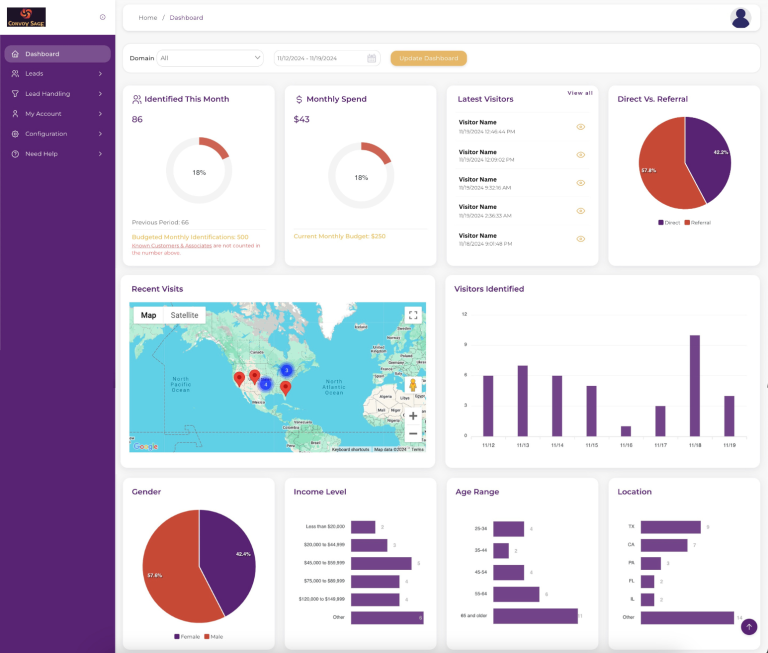
In addition to gathering emails and LinkedIn information, Convoy Sage provides valuable insights about your website visitors that can help you refine your strategy and better engage with potential leads. Here’s how you can maximize those data points:
  1. Analyze Visitor Frequency

    Take a close look at how often certain visitors return to your site. Convoy Sage tracks this information, allowing you to identify those who are consistently visiting. Frequent visits could indicate a higher level of interest, and this is your cue to reach out with more targeted messaging or offers. Visitors who repeatedly engage with specific pages (such as product pages or case studies) can be considered stronger leads, and reaching out to them promptly could yield high conversion rates.

    Tip: Focus on high-frequency visitors and tailor your outreach to reflect their interest in specific pages. The more data you have on their behavior, the more personalized your message can be!

  2. Track Lead Activity in Relation to Known Customers

    If a visitor matches an existing customer in your CRM or database, it’s useful to categorize them accordingly. By linking leads to known customers, you can prevent double-charging for visits, while still tracking their activity and engagement levels. It’s a great way to keep an eye on existing clients without losing track of their activity.

    Tip: Keep your known customer list up-to-date to avoid unnecessary charges and ensure you can see when a current client revisits your site. This insight can also help with upsell or cross-sell opportunities.

  3. Understand Industry 
    See which industries your website visitors are coming from to ensure your website content and marketing efforts reach the right sectors. If you’re attracting traffic from unexpected industries, considering expanding your targeting or adjusting your messaging to better align with your target market. 

  4. Partnership Potentials
    Use Convoy Data to identify companies who could be valuable partners rather than just customers, which are great for referrals or industry partnerships. 

  5. Understand Capital and Financing Needs 
    Often companies in the financial sector will scout potential acquisition partnerships, use this intel to understand  which firms may be evaluating your business or exploring opportunities in your industry.

General Best Practices

To get the most out of Convoy Sage, here are some simple best practices to keep everything running smoothly and ensure you’re maximizing the value of your leads.

  1. Log in at Least Once a Week – Stay up to date on new leads and visitor activity to catch high-potential prospects early.
  2. Check for Repeat Visitors – Frequent visitors can signal strong interest. Keep an eye on who keeps coming back.
  3. Review Your Traffic Sources – See where your visitors are coming from (Google Ads, LinkedIn, referrals, etc.) to adjust your marketing efforts accordingly.
  4. Tag and Organize Leads – Keep track of key contacts by tagging them or noting their activity patterns. This helps prioritize follow-ups.
  5. Export Leads Regularly – Don’t let valuable data sit unused—export leads and integrate them into your CRM or email campaigns.
  6. Update Your Known Customer List – Prevent duplicate charges by adding existing clients to your known customer list while still tracking their visits.
  7. Adjust Based on Insights – Use the data Convoy Sage provides to tweak your outreach strategy, website content, or ad spend.
  8. Ask for Support if Needed – If you ever have questions or need help maximizing the platform, reach out. We’re here to help!